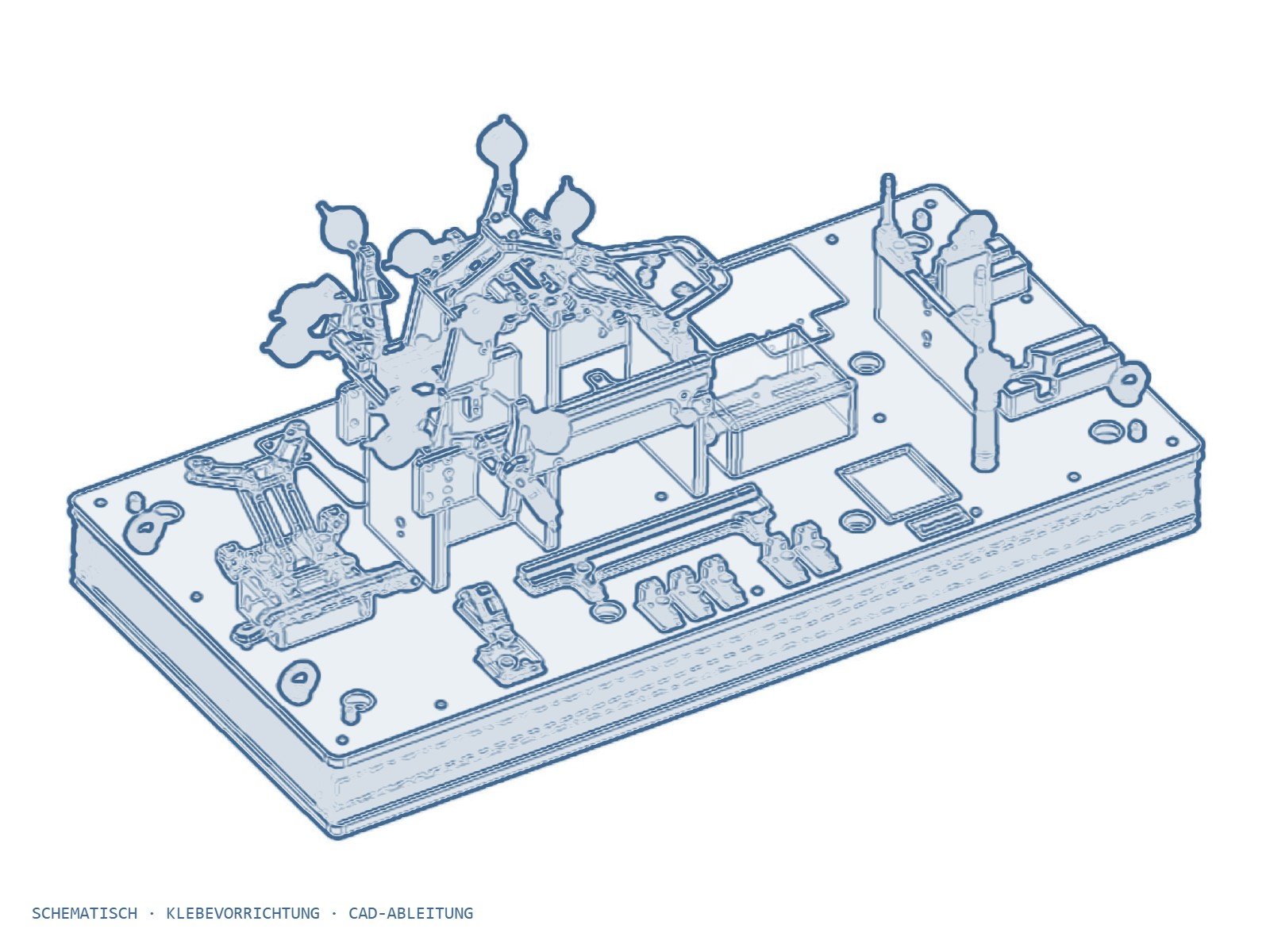
Fixture type 05 / 07
Bonding and joining fixtures for defined bond gaps and secure fixing during curing — for a clean, repeatable bonding process.
· In use
Bonding does not forgive undefined positions: bond gap, contact pressure and fixing time determine the quality of the joint. We develop bonding fixtures that position the parts to be joined exactly relative to each other and hold them securely throughout curing — even with sensitive surfaces.
As with all our fixture types, we choose the manufacturing process to suit the application — CNC machining, 3D printing and post-processing, individually or combined as a hybrid. You receive the complete fixture from a single source, from design to commissioning.
· Scope of services
· Application
A bonding fixture pays off when parts are bonded structurally or in visible areas and both position and bond gap have to be right after curing: when bonding in inserts and holders, when joining fibre-composite and plastic parts, and for housings and trim panels. It holds the parts throughout the entire curing time and makes the process independent of the operator.
We design the bonding fixture to suit the adhesive and the process: spacers for the bond gap, defined contact pressure, nests that do not mark the surface, and clearances so that escaping adhesive does not bond the fixture to the part. Nests close to the part are often 3D printed, base bodies CNC machined.
· Frequently asked questions
By fixed spacers and stops in the fixture. The parts rest in a defined position; the bond gap results from the design and not from the operator's feel.
We provide clearances at the bonding points and design the contact surfaces so that escaping adhesive does not reach the fixture or can easily be removed.
Yes, if temperature and duration are known. We then select materials and construction accordingly and take thermal expansion into account.
In many cases yes, using interchangeable nests. Whether this makes sense is something we check against your range of parts.
· More fixture types
Tell us about your part, process and quantity — we will get back to you within 24 hours.